
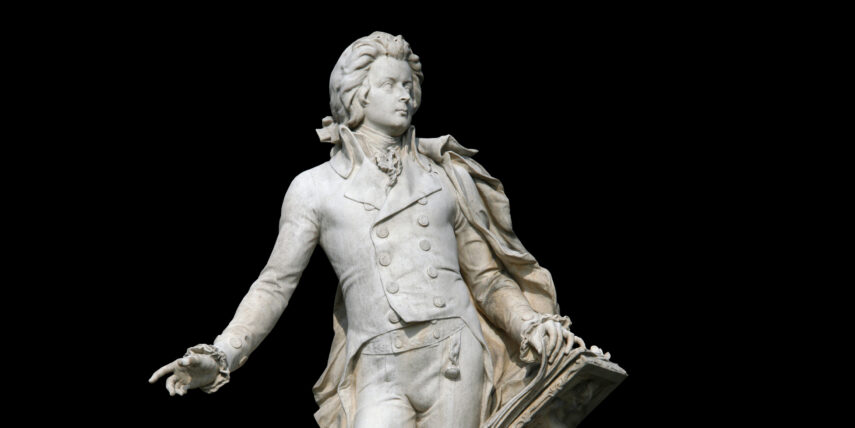
Mozart died at the age of 35, before he had completed the Requiem. There is a peculiar fascination for all of us in a work that was still in the making when its composer died – Schubert’s Unfinished Symphony, Puccini’s Turandot, Bach’s Art of Fugue.
But Mozart’s story is so sensational as to defy belief: One of the world’s greatest composers dies while writing what transpires to be his own requiem. It’s possible that Mozart’s wife, Constanze contributed to the mystique by sharing her concerns for her husband’s mental health during the months before his death. By her account, his habitual optimism, at times bordering on childishness, had given way to an incorrigible pessimism. When on an outing to Vienna’s amusement park, Mozart ‘began to speak of death, and declared that he was writing the Requiem for himself … “I feel definitely,” he continued, “that I will not last much longer; I am sure I have been poisoned.”’
What caused Mozart’s outburst? He had been suffering from intermittent chills and fevers, but a dark subplot haunted him.
A Viennese aristocrat, Count Franz von Walsegg liked to pay composers handsomely and then take the credit for the music that they had composed. In the 1984 film Amadeus, a cloaked messenger arrives at Mozart’s door, something like the terrifying masked apparition in the final scene of the opera, Don Giovanni (1787). The anonymous messenger offers the princely sum of 50 ducats as an immediate 50% downpayment if the work can be completed in four weeks. In July 1791, Mozart accepted the commission. It’s easy to understand how this disturbing undercurrent, coupled with intermittent fevers could have contributed to his anxiety level and perhaps even to his death.
In spite of anxiety and bouts of fever, during the last twelve months of his life, Mozart composed prolifically: The Magic Flute, La Clemenza di Tito, the final piano concerto (K595 in B flat), the greatest clarinet concerto ever written and the K614 string quintet, to name only a handful of immortal compositions. The Ave verum corpus (K618) for choir and orchestra (to be performed alongside the Requiem by the ACC) also dates from this final outpouring. Mozart possessed the genius to write a brilliant requiem in four weeks, but he was far too busy with other commissions.
On 20 November 1791, he retreated to his bed suffering from stomach pain and vomiting. Nobody can be sure of what illness overcame him, and on 5 December, forever silenced him. Some have sought to place the blame on a subdural haematoma. Others blame rheumatic fever. Still others unglamorously attribute the collapse to roundworm infestation, via meat not properly cooked. Then there are those who ascribe Mozart’s condition to over-reliance on quack medicaments containing lead; to a streptococcal infection; or to medical malpractice (a hypothesis circulated at a remarkably early stage, its adherents having included Constanze’s sister Sophie). And for some conspiracy theorists Mozart’s death can be explained as murder: General Erich Ludendorff (1865–1937), for example, supposed that Mozart was assassinated by Masons (who allegedly could not forgive him for exposing craft secrets in The Magic Flute). As for the notion that fellow composer Antonio Salieri slew Mozart, the complete lack of evidence implicating Salieri did not prevent spiteful Viennese gossips at the time from spreading the rumour. Parallels exist in our own time to such hysterical concoctions of ‘fake news.’
Mozart left the Requiem approximately two-thirds finished. Constanze, distraught by grief and in debt, was worried about when (or whether) the remainder of the commission fee would be paid. She assigned the Requiem’s completion to the 25-year-old Viennese musician Franz Süssmayr, who delivered the finished work in little more than three months. Still unaware of the identity of the patron, she followed instructions to deliver the completed manuscript and retrieve the remainder of the commission fee.
Count von Walsegg had the work performed in the Neuklosterkirche in Vienna’s Neustadt on 14 December 1793. The score on this occasion was in his own hand, and bore his name “Fr. C(omte) de Wallsegg” as the composer! He repeated the deception in February 1794.
Possibly unknown to Walsegg, a performance of Mozart’s completed Requiem had already taken place in January 1793 as a fund raiser for Constanze and her children. Thankfully, with the spreading news that Mozart had written a Requiem on his deathbed, Walsegg was faced with some embarrassing questions, forcing him to abandon any further plans to present the Requiem as his own.
While more than a dozen other completions of the Requiem have been released in the last four decades, most ensembles do keep returning to Süssmayr. The ACC’s performance will mark the 230th anniversary of the work’s first performance.
Click here to read about Mozart’s first experience hearing a Bach Motet during a visit to Leipzig.
Click here to read the program notes for the ACC’s performance of Mozart’s Requiem.