
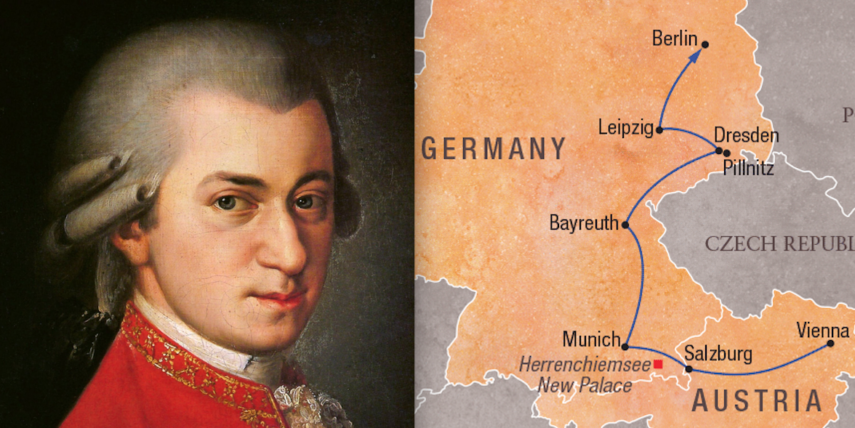
Genius — it takes one to know one!
On 20 April 1789, the 33 year old Mozart arrived in Leipzig. He visited the famous Thomaskirche to pay homage to JS Bach, who had served as Cantor there several decades earlier. The visit had a profound affect on his compositional style.
In charge of the Thomanerchor at this time was Bach’s pupil, Johann Doles. The choir took time out from their rehearsal to perform for Mozart Bach’s Motet Singet dem Herrn ein neues Lied (BWV 225).
As soon as the choir had sung a few bars, Mozart exclaimed ‘What is that?’ Friedrich Rochlitz, an eye witness, reported how Mozart was swept away by the experience, exclaiming “Here is something that one can learn from”. On learning that the school library held a complete set of Bach’s Motets, Mozart asked to see them immediately. There were, however, no complete scores. Mozart then poured over the individual voice parts, laying them out all around him. “Forgetting everything else, he did not stand up again until he had looked through all the music of Sebastian Bach”.
In his Anecdotes from Mozart’s Life (1798-9), Rochlitz wrote “no one who knows Bach’s compositions and Mozart’s Requiem will fail to recognise, particularly in the great fugue, Kyrie Eleison … the full comprehension of the … contrapuntalist (Bach) achieved by Mozart’s versatile and unlimited genius”.
When Mozart died in 1791, this fugue was the last movement of the Requiem that he had completed. The remainder had to be reconstructed from his sketches and instructions. Click below to listen to the Kyrie eleison fugue from Mozart’s Requiem. The rolling score is annotated so that you can identify every subject entry in this tightly-constructed fugue.