
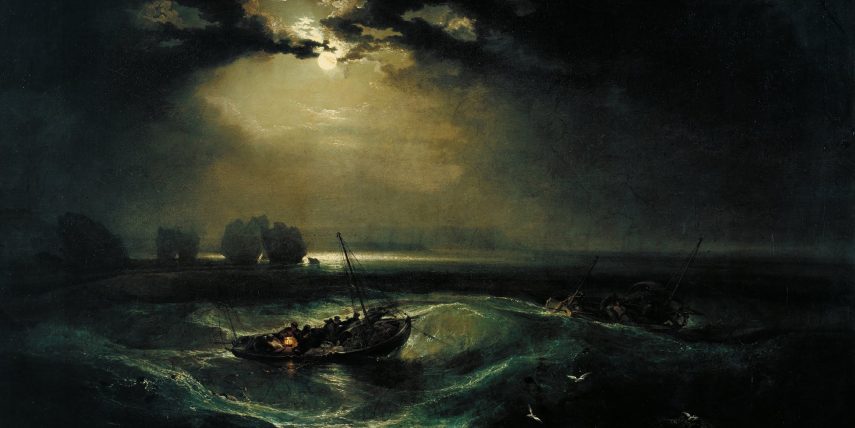
Fishermen at Sea (detail), 1796, oil on canvas, JMW Turner, The Tate Gallery, London
In the hands of Romantics like Verdi, Bruckner and Brahms, music became increasingly expressive, harmonically inventive, passionate and theatrical. In the early twentieth century, composers like Edward Elgar, Amy Beach, and Sergei Rachmaninoff resisted the atonality and serialism embraced by their contemporaries and continued to explore the rich extremes of lush romantic harmony. Later in the twentieth century and still today, composers like Samuel Barber and Michael Trotta delight audiences with music that has more in common with romantic idioms than with modernist trends. Together, these “Greater Romantics” provide us with a program that runs the gamut from emotionally-charged to blissfully peaceful. Read the detailed program notes.
Two German Romantics
Johannes Brahms (1833–97) Warum ist das Licht gegeben
Josef Rheinberger (1839–1901) Abendlied
From St Florian Abbey, Austria
Anton Bruckner (1824–96) Christus factus est
Two settings of Ave Maria
Giuseppe Verdi (1813–1901) Ave Maria
Sergei Rachmaninoff (1873–1943) Bogoroditsye Dyevo
Two English Late Romantics
Edward Elgar (1857–1934) Nimrod (arr. Anderson)
Edward Bairstow (1874–1946) Let all mortal flesh keep silence
Two works by Samuel Barber (1910–81)
Agnus Dei Op.11 (1967)
Twelfth Night (1935)
More American Romantics
Amy Beach (1867–1944) Help us, O God (Largo) Op.50 (1903)
Michael Trotta (born 1978) Dies irae (c.2020)