
To mark the screening of the documentary, Agatha’s Story on SBS OnDemand and to celebrate Agatha’s life and work, including her first CD recording, the ACC presents
Agatha’s Cantata, Vivaldi’s Gloria
Vivaldi’s Gloria was written for the famous all-female ensemble of Venice’s Ospedale della Pietà. During Vivaldi’s time teaching at this orphanage (1703-40), the Pietà developed an international reputation for its musical performances, presented exclusively by the young women who were educated there.
Agatha’s Cantata
Born with only one finger on her left hand, Agatha was abandoned to the Ospedale della Pietà on the day of her birth in 1712. She spent her entire life at the orphanage: Given a thorough musical education, she grew up to become a singer, teacher, composer and finally, the Prioress and Director of Music.
Elizabeth Anderson discovered the surviving manuscripts of Agatha’s Cantata in a Venice library while researching for an ACC program. As some of the manuscript parts had been lost, she immediately began work on a reconstruction, keen to give modern audiences the opportunity to hear the music of a hitherto unknown composer brought to life after a silence of some 300 years. This is, to date, the only surviving composition by an orphan of the Ospedale della Pietà.
Agatha’s Cantata, Vivaldi’s Gloria
PROGRAM
Giovanni Pierluigi da Palestrina (1525–94) Tu es Petrus
Antonio Vivaldi (1678–1741) Gloria (RV589)
For soprano and alto soloists, choir and orchestra.
Gregorio Allegri (1682–1652) Christus resurgens
Agatha della Pietà (1712–69) The Cantata, Ecce nunc reconstructed by Elizabeth Anderson, for soprano and alto soloists, choir and orchestra
“The ACC has revealed a composer who combined technical rigour with expressive warmth” – The Age
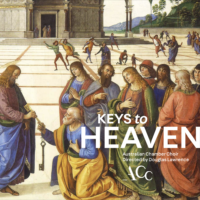 Keys to Heaven is the premiere recording of Agatha’s Cantata, as heard on ABC Classic FM.
Also on this CD
Giovanni Pierluigi da Palestrina – Tu es Petrus and Missa Aeterna Christi munera
Gregorio Allegri – Christus resurgens and Miserere
“a small Venetian jewel shines again after 300 years” – Limelight
 Who is the little girl in the mosaic? Agatha lived her life within the walls of an institution, and as far as we know, was never recognised for her talent as a composer. To date, no portrait of Agatha has come to light. It’s tantalising to think that a short walk from Agatha’s door, on the Grand Canal in Venice, was the studio of one of the most successful women artists of the era: Rosalba Carriera (1673–1757) became famous for her portrait miniatures, and received so many commissions that she became more wealthy than male colleagues like Canaletto. If anyone had wanted to commission a portrait of Agatha, Carriera would have been a perfect choice. The portrait in the mosaic is from Carriera’s pastel on paper likeness of Elisabetta Caterina Le Blond (1723–c.1730), daughter of the French Consul to Venice, Jean-François Le Blond, who also commissioned a portrait of himself. It is likely that the French Consul, if not his daughter, would have visited the Ospedale della Pietà, as French diplomats were among the foreign visitors who attended performances there. We are sorry that a portrait of Agatha was not procurable. We hope that this portrait by a local artist, of a child who lived in Venice at the same time, will lend authenticity to our poster. The portrait, probably created in 1730, can be found in the Galleria dell’Accademia, Venice.