
Download a pdf of the listening map
Alleluja! Be joyful! is a piece by German composer, Andreas Hammerschmidt. Hammerschmidt wrote this piece for Christmas, probably in the year 1649 or 1650. He was the organist of the church in Zittau, Germany. He wrote all his music for his church choir.
The A C C 8 will sing this song as part of their European Cultural Capitals program, live-streaming on Sunday afternoon 28 June.
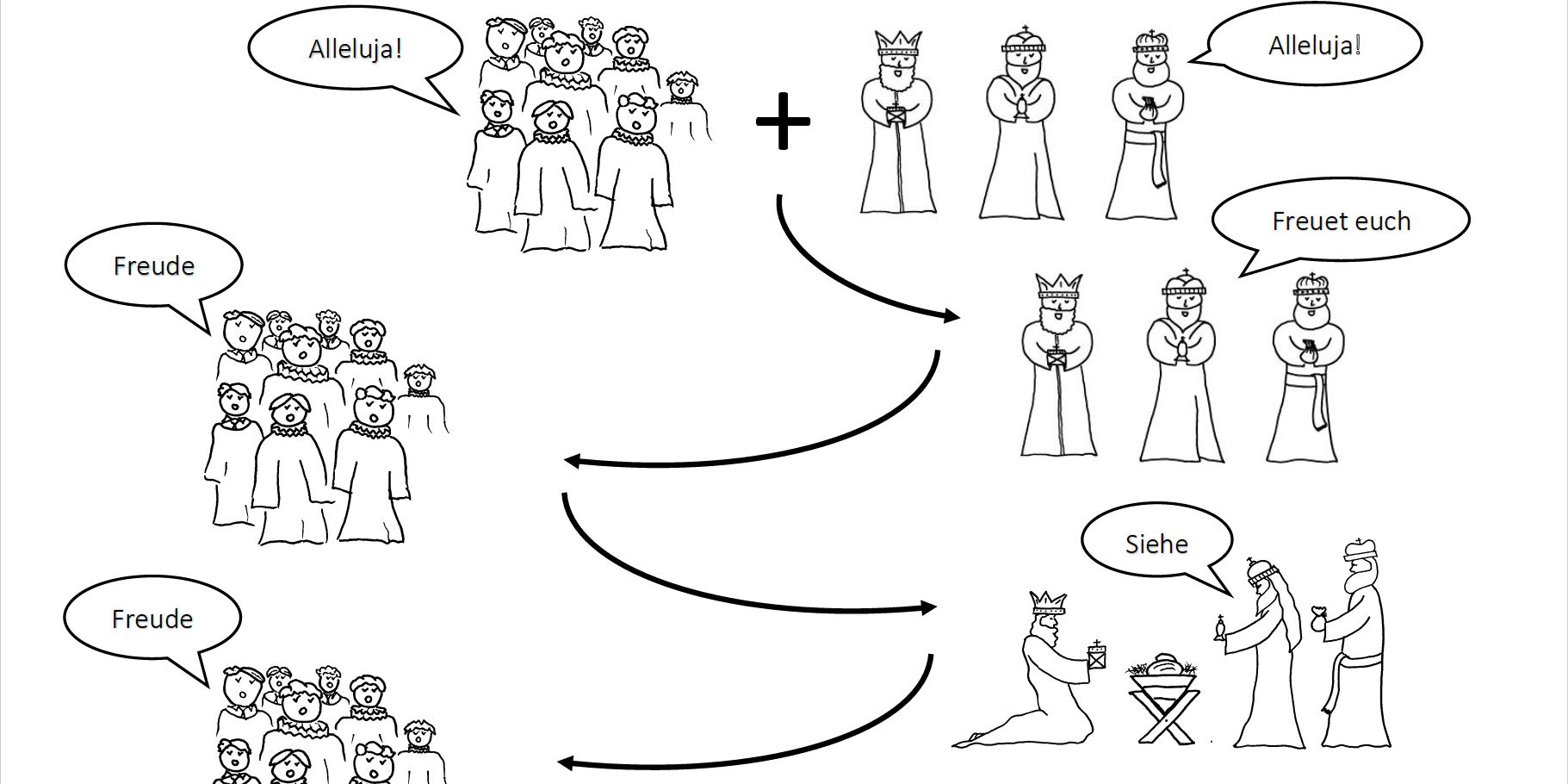
Click here to download the full version of the picture above. If you want to, you can print it out and colour it in. We call this picture a ‘listening map’. Following the arrows, the pictures will help you to notice the different sections in the song.
Click below to listen to the song. While you are listening, you might like to continue reading below for some instructions to use the listening map.
This song is written for a choir with three male soloists. At the beginning, you hear the choir singing Alleluja! Actually, the three soloists are singing with the big choir, but as everybody is singing at the same time, you can’t really hear the soloists.
After the first section, you can hear just the three soloists with the organ. In music, when three people sing or play together, it is called a trio. Can you think of another word that contains the letters ‘tri’ that also has something to do with the number three? The trio sings the words Freuet euch. This is German for Be joyful. Using the listening map and following the arrows, can you work out what will happen next?
The next section is sung by the whole choir. They sing Freude, freude, which is German for Joy, joy. When the trio sings again, they sing Siehe, siehe, which is German for See, see. The words that follow talk about the baby Jesus.
See if you can trace your finger on the listening map while you listen to the song. Don’t worry if you don’t hear all the different sections the first time.
Notes for Mums and Dads
Follow the instructions above yourself and/or show your children the page. The activity is designed for children between the ages of 8 and 14. The concert begins at 5.00 pm on 28 June and lasts for one hour. A ticket for your entire household costs $24. More…
Live-streamed concerts such as this one are an ideal opportunity to introduce your children to classical music concerts. You can talk to them throughout the concert to help them to engage with the music. You can encourage younger children to dance to the songs. Here are some questions that you might ask your children:
“How many people do you think are singing right now?”
“Are we listening to men’s voices, women’s voices or men and women singing together?”
“Do you know any of the special names for the high and low voices?” (Click here to download a worksheet introducing the terms soprano, alto, tenor and bass)
“Could you dance to this song? What kind of a dance would you make up for this song?”
“What was your favourite piece of music in the concert? Why did you especially like that song?”
“Let’s pretend that all the composers in this concert are in a competition to write the best piece of music for choir. Let’s pretend that you are the judge of the competition. Which composer will win first prize?”